
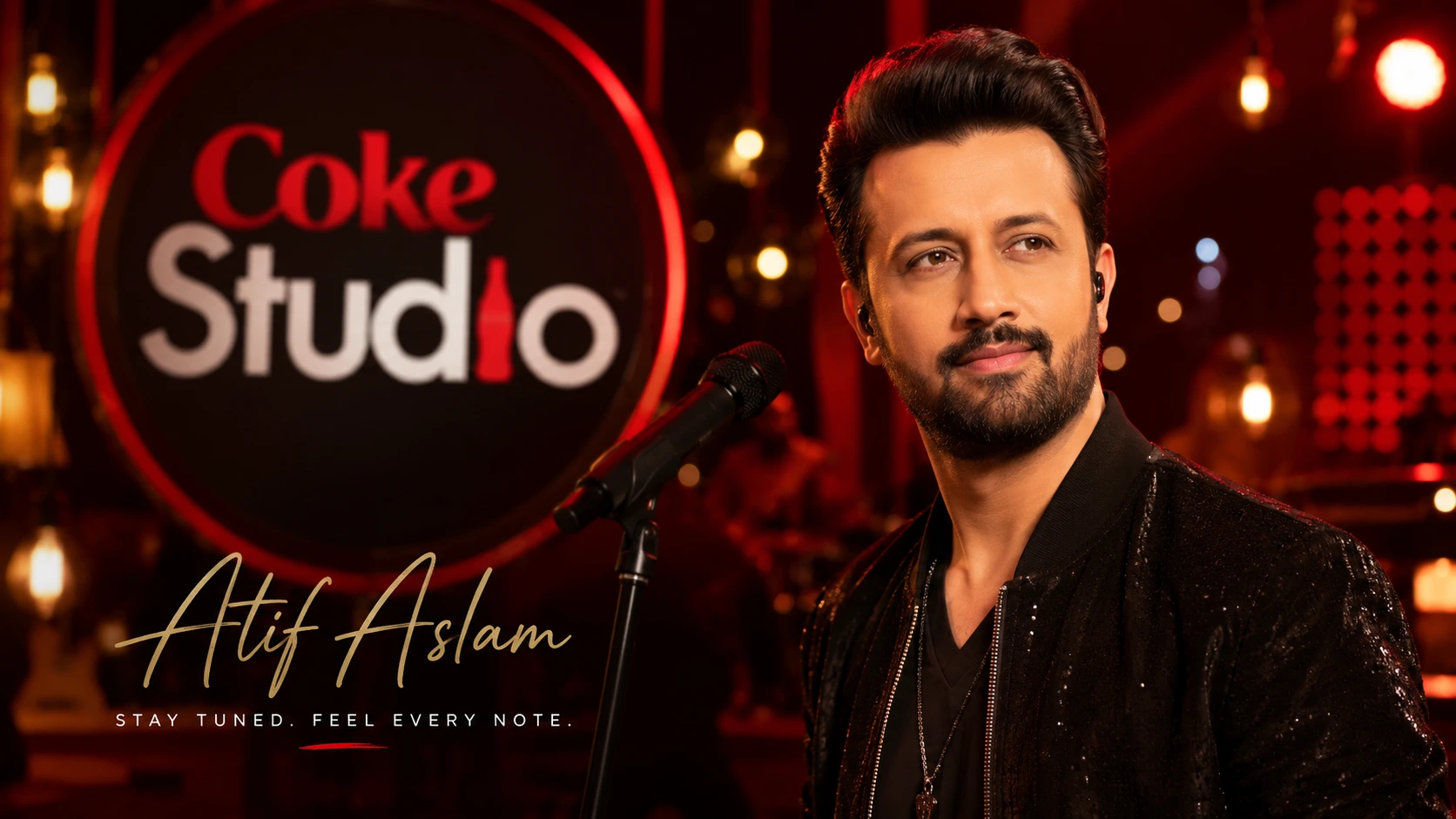
Atif Aslam says Pakistan’s Coke Studio is better than India’s; Pakistani songs possess a certain magic, whereas Indian music is driven more by commercialisation.
Pakistani singer Atif Aslam has compared the popular ‘Coke Studio’ music platforms of India and Pakistan, deeming the Pakistani version to be superior.
In an interview, Atif stated that the success of Coke Studio Pakistan stems from its ‘raw and original’ music, whereas ‘commercialization’ appears to be more dominant in Coke Studio India.
Table of Contents
“Commercialisation Dominates Indian Music”: In an interview with the Dubai-based radio station Mirchi UAE, Atif Aslam discussed the working styles of Coke Studio in both countries. Atif remarked that while excellent musical compositions are created on both sides, Indian music lacks the “rawness” found in our songs.
Indian Coke Studio relies heavily on commercialisation and tailors songs to suit market trends. In contrast, Pakistani Coke Studio places complete emphasis on original compositions. Musicians there have the freedom to showcase their artistry; in a sense, it is a ‘do-or-die’ situation for them, allowing them to establish a unique identity.
Coke Studio Pakistan was launched in 2008. Its founder and producer was Rohail Hyatt. The show elevated fusion music to new heights by blending traditional Sufi, Qawwali, Ghazal, and folk music with modern Western instruments.
- YouTube Subscribers: Coke Studio Pakistan’s official YouTube channel has over 17.7 million subscribers.
- Most Popular Songs: The song ‘Pasoori’ (by Ali Sethi and Shae Gill) from Coke Studio Pakistan Season 14 became a massive global hit, garnering over 990 million views. Other all-time blockbuster songs on the platform include ‘Afreen Afreen’ by Rahat Fateh Ali Khan and Momina (over 670 million views) and ‘Tajdar-e-Haram’ by Atif Aslam (over 650 million views).
Coke Studio India was launched in 2011. Coke Studio made its debut in India in 2011 under the name ‘MTV Coke Studio India’. In the early seasons, musicians such as A.R. Rahman, Amit Trivedi, and Clinton Cerejo created numerous outstanding original tracks; however, in later years, the platform came increasingly under the influence of the Indian film industry and Bollywood composers.
- Rebranding and Subscribers: It was relaunched as ‘Coke Studio Bharat’ in 2023. Currently, the ‘Coke Studio Bharat’ YouTube channel has approximately 7.2 million subscribers.
- Popular Songs: The biggest recent hit from Coke Studio India was Anuv Jain’s ‘Arz Kiya Hai’, which garnered over 230 million views on YouTube. Following closely is the song ‘Ki Banu Duniya Da’ by Diljit and Gurdas Maan, which also has over 230 million views. Meanwhile, the Gujarati song ‘Khalasi’ has crossed the 180-million-view mark on YouTube. Additionally, ‘Chaudhary’ by Mame Khan and Amit Trivedi, as well as ‘Madari’ by Vishal Dadlani and Sonu Kakkar, were widely appreciated.
Addressing the ban imposed on him in India, Atif Aslam remarked that people listen to his music via VPN and that he misses his fans. He shared these thoughts during a conversation on radio presenter Kris Fade’s YouTube channel.
During the conversation, Atif Aslam said, “It has been about 10 years since I was banned in India. It was a decision made by the Indian government; they decided to ban Pakistani artists. Indian artists are also banned in Pakistan—and have been for the past 10 years. I haven’t released any songs there.”
Noting how Indian fans consistently listen to his music, he mentioned that people use VPNs to access his songs and even burn them onto CDs to share with others. He stated that while he does not condone piracy, music inevitably finds its way to its audience; the same thing happened with his debut single.

Atif Aslam told Indian fans not to be disheartened
Addressing his Indian fans, Atif said, “Yes, don’t feel bad about this. Don’t be sad. I’ve always wanted to tell you all that I miss you. I don’t miss working there, but I do miss you all.”
Atif added, “I have learned a great deal from playback singing. Had that ban not happened, I might not have been able to create my own music. So, I thank you all for that as well.”
Why were Pakistani artists banned?
Tensions between India and Pakistan escalated following the Uri terror attack in September 2016. During this period, the Indian Motion Picture Producers Association (IMPPA) instructed its producer members not to hire Pakistani artists and technicians until relations between the two countries normalised.
However, even after 2016, songs by Atif Aslam continued to feature in several Bollywood films. In 2017, tracks such as “Dil Diyan Gallan” (Tiger Zinda Hai), “Darasal” (Raabta), “Main Agar” (Tubelight), and “Jaane De” (Qarib Qarib Singlle) were released.
Similarly, in 2018, songs like “O Saathi” (Baaghi 2), “Paaniyon Sa” (Satyameva Jayate), “Tera Hua” (Loveratri), and “Dil Meri Na Sune” (Genius) were released. However, no songs by him have been released in Bollywood films since March 2019.
It is worth noting that a few days after the Pulwama terror attack in February 2019—which claimed the lives of 40 CRPF personnel—the All India Cine Workers Association (AICWA) announced a complete ban on Pakistani actors and artists within the Indian film industry.
Tensions between India and Pakistan escalated following the terror attack in Pahalgam. Subsequently, the Government of India imposed a ban on Pakistani films, web series, songs, and podcasts.
The Ministry of Information and Broadcasting ordered the removal of Pakistani content from platforms such as OTT services and YouTube, acting under the IT Rules 2021.
Additionally, the social media accounts of several Pakistani artists—including Mahira Khan and Hania Aamir—were temporarily blocked in India.
Also Read | Top 10 Bollywood Actress with Most Instagram Followers 2026
I am Ankit Mishra from Sitapur, Uttar Pradesh, the founder and content writer of this website. I primarily work in the entertainment and sports niche, where I publish detailed and original content related to Bollywood, Hollywood, Cricket, WWE and Celebrities Wiki. I believe in providing clear, honest information. All content on this platform is written by me with a focus on quality, reliability, and real user needs. I am an SEO Analyst, and I have worked for many agencies in Lucknow. Also, I love to capture photos.
1 thought on “Atif Aslam says Pakistan’s Coke Studio is better than India’s”
Comments are closed.